

Hyperskill vs Udemy: Project-Based Learning vs. Video Courses

Hyperskill vs Udemy: Project-Based Learning vs. Video Courses
Introduction
Hyperskill and Udemy represent two fundamentally different philosophies about how developers learn. Udemy is the world's largest online course marketplace: tens of thousands of courses, instructors from every background, prices that drop to a few pounds during sales that run almost continuously. If breadth and affordability are what you're optimising for, Udemy is hard to beat.
Hyperskill, powered by JetBrains, takes the opposite approach. A focused, structured curriculum built around real projects inside professional IDE tooling — IntelliJ IDEA for Java and Kotlin, PyCharm for Python. No marketplace, no variable instructor quality, no watching videos and hoping the knowledge sticks. The primary activity is building, and the output of a course is a GitHub portfolio of deployable applications.
The question for working professionals is not which platform has more content. It is which platform produces the outcome you actually need: the ability to write production-quality code, work in professional tooling, and demonstrate real competency in a technical evaluation. This comparison focuses on exactly that.
How Each Platform Builds Skill
Hyperskill: build first, theory on demand
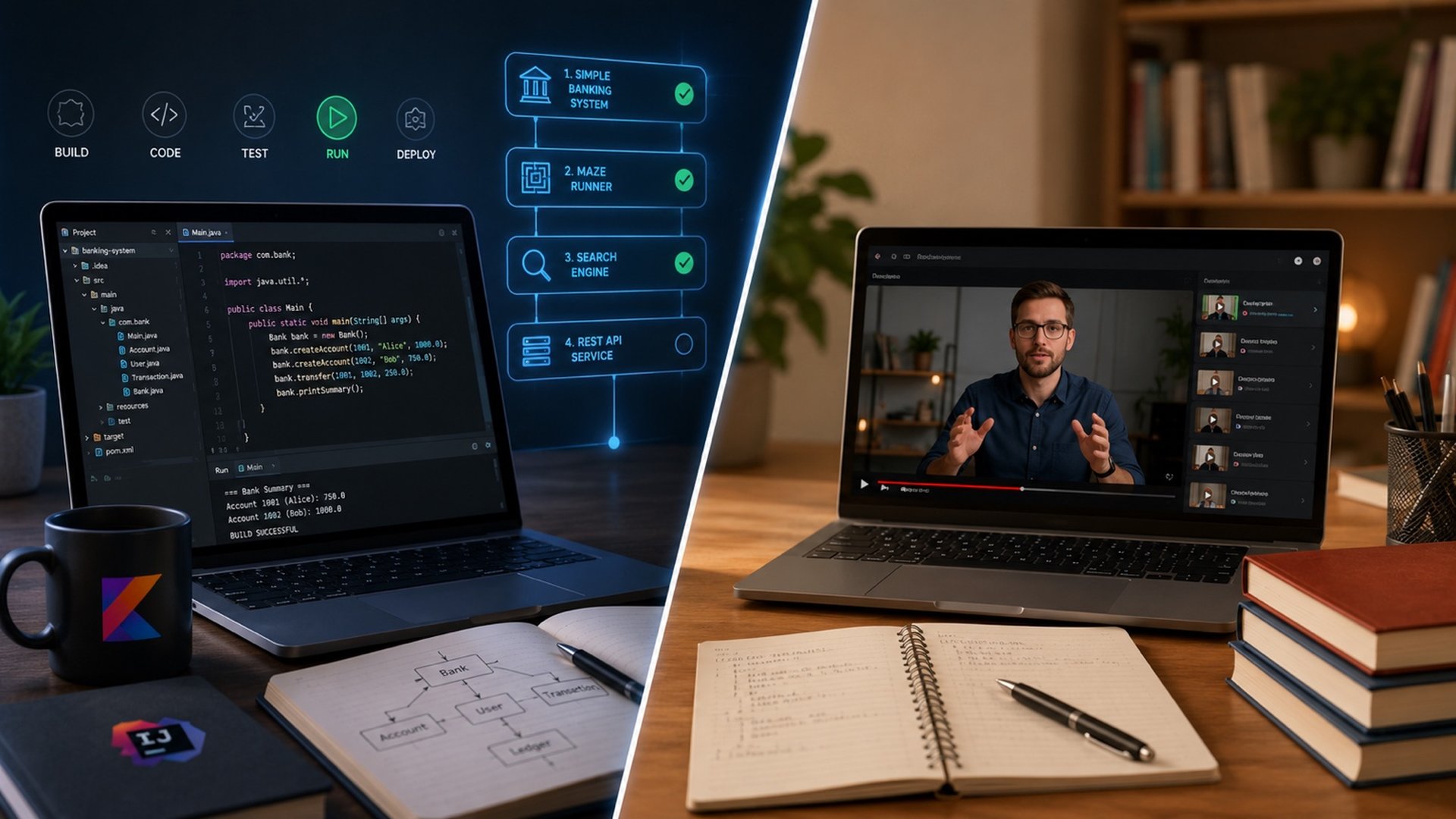
Hyperskill runs on an 80% practice / 20% theory model. The moment you start a course, you are building — real projects, inside IntelliJ IDEA or PyCharm, with automatic grading and real-hour estimates. Theory is available on demand, surfaced in context when you encounter a concept you need rather than front-loaded before you write a line of code.
The platform offers dedicated courses for Java, Kotlin, and Python across multiple professional trajectories. The Java Developer course takes you through a progression of complete applications — a Simple Banking System, a Maze Runner, a Simple Search Engine — each independently deployable, GitHub-ready, and graded for correctness. The Java Backend Developer (Spring Boot), Python Backend Developer, and Kotlin Developer courses follow the same model. By the time you finish a course, you have six to ten substantial projects on GitHub. The portfolio is not something you build after completing the curriculum — it is the curriculum.
The self-paced structure suits professionals who cannot commit to fixed schedules. Hyperskill estimates each project in real hours, which means you can map your available weekly time to a realistic completion date rather than guessing how long a course will take.
Udemy: watch, follow, hope it sticks
Udemy is a marketplace of individually sold courses. Its Python and Java catalogs are among the most extensive available online. Promotional pricing, often running almost continuously, brings most courses to the £10–20 range. Lifetime access to purchased courses is a real advantage for professionals who study in bursts and need to revisit material over time.
The model is fundamentally lecture-first. You watch, you follow along, you complete exercises that are scoped to the lecture's content. There is no structured project progression across a curriculum — each course is its own standalone experience, and building a portfolio of real applications is entirely the learner's responsibility. Completion certificates confirm that you watched the videos. They do not confirm that you can build anything independently.
The most significant limitation is quality variance. Because Udemy is an open marketplace, course quality ranges from excellent to outdated, and the platform's rating system is an imperfect guide — highly-rated courses may cover library versions that are years behind current practice. Vetting courses for recency and instructor credibility before purchasing is not optional; it is part of using Udemy effectively.
The Core Difference: What You Walk Away With
This is where the comparison is sharpest, and where working professionals need to be clear-eyed about what they are actually buying.
After completing a Hyperskill course, you have a GitHub portfolio of six to ten complete, deployable applications — built inside a professional IDE, graded for correctness, with a commit history that reflects real development. You can open any of those projects in a technical conversation and discuss the architecture, the decisions you made, the problems you encountered. That portfolio is the direct output of the curriculum.
After completing a Udemy course, you have a completion certificate and the knowledge from the lectures. The portfolio, if you build one, is a separate project you undertake yourself. Many Udemy learners finish long courses and have nothing on GitHub they could show a technical interviewer, because the course's exercises were browser-based or follow-along rather than independently built. The knowledge may be there; the demonstrable evidence is not.
For working professionals whose primary goal is to become more employable or to demonstrate competency in a new language or framework, this difference is decisive. A portfolio of real projects answers the question a technical evaluator is actually asking: can this person build something? A completion certificate does not.
Head-to-Head: Key Dimensions
Learning format
Hyperskill is project-first throughout. Every course is structured around building complete applications, with theory available on demand. There are no passive consumption phases — the primary activity from day one is writing code that runs, encountering real problems, and solving them independently. For professionals who find video consumption slow and frustrating, this is a materially different experience.
Udemy is lecture-first throughout. The standard format is a video lecture followed by exercises that reinforce the lecture's content. The exercises are scoped to individual concepts rather than to a complete project, which means the cognitive challenge of integrating skills into a working application is left to the learner. For professionals who prefer structured explanation before attempting practice, this format is comfortable. For those who want to build from the start, it feels like a long runway before any actual flying.
IDE and professional tooling
Hyperskill integrates IntelliJ IDEA and PyCharm directly into the learning experience from day one. You work in the same IDE you will use professionally, with the full suite of code intelligence, inspections, refactoring tools, and debugging capabilities available throughout. By the time you complete a course, professional toolchain fluency is a byproduct of the learning — not something you need to develop separately afterward.
Udemy courses vary significantly in their tooling approach. Some instruct learners to use IntelliJ or PyCharm; others use browser-based environments or assume a local setup without guidance. The tooling experience is entirely dependent on the individual course instructor's choices, which means it is inconsistent across the catalog. Developers who finish a Udemy course and then encounter a professional development environment for the first time may find the transition more jarring than expected.
Curriculum structure and progression
Hyperskill offers a structured, curated curriculum with clear progression from fundamentals to production-relevant work. The course design is coherent — each project builds on the last, the theory coverage is systematic, and the learning path is designed by people who understand what professional development work requires. There is no decision overhead about what to study next.
Udemy offers individual courses with no enforced progression between them. This is simultaneously its greatest flexibility and its greatest weakness for developers who need comprehensive coverage. A developer who purchases five Udemy courses on related topics will find overlapping content in some areas and gaps in others, with no curriculum design ensuring systematic skill development. Self-directed learners who know exactly what they need can use this flexibility well; those who are less certain about their gaps often end up with an uneven skill set.
Content quality and recency
Hyperskill maintains a curated, consistent curriculum. The platform controls content quality directly, which means courses are updated when the language or ecosystem changes and the material reflects current professional practice. There is no quality variance between courses — the same standard applies throughout.
Udemy is an open marketplace where quality is determined by individual instructors. The best Udemy courses are genuinely excellent; the worst are outdated, poorly structured, or both. A course with thousands of five-star reviews may cover a framework version that is years behind current practice — the ratings reflect the experience of learners who may not have known what they didn't know. Checking the last update date and scanning the Q&A for mentions of outdated content is essential before purchasing.
Pricing and access model
Hyperskill operates on a freemium model. The free tier provides meaningful access to content, with full access to all project-based courses available on a paid subscription. The subscription model means your access is continuous as long as you subscribe, which suits professionals pursuing an extended, structured curriculum.
Udemy sells courses individually, typically at promotional prices of £10–20 during sales that run almost continuously. Lifetime access to purchased courses is a genuine advantage — you can return to a course years later without any additional cost. For professionals who need targeted coverage of a specific topic rather than a complete curriculum, the per-course model is more economical than a subscription. The trade-off is that building comprehensive coverage through individual course purchases adds up, and the total cost of assembling a full curriculum from Udemy courses often exceeds a Hyperskill subscription.
Side-by-Side Comparison
Which Platform for Which Situation
Choose Hyperskill if:
Your goal is to reach professional competency in Java, Kotlin, or Python with a portfolio to show for it. You want a structured curriculum that tells you what to learn next rather than requiring you to assemble one yourself. You want to work in IntelliJ IDEA or PyCharm from day one. You are a career switcher or a developer adding a language to your stack and need the output of your learning to be demonstrable project work, not completion certificates. You learn best by building and find passive video consumption slow or ineffective.
Choose Udemy if:
You need targeted, affordable coverage of a specific topic — a single framework, a specific library, one area of a language you don't yet know well. You already have professional development experience and know exactly what gap you need to fill. You want lifetime access to reference material you can return to without a recurring subscription. You are disciplined about building independent projects alongside your coursework and don't need the curriculum to produce portfolio output for you.
Consider both if:
You are using Hyperskill for structured, project-based curriculum and Udemy for targeted supplementary coverage of specific topics the curriculum doesn't cover in depth — a specific library, an advanced framework feature, or a niche area of the language. The two platforms are not in competition in this mode; Hyperskill handles the structured progression, Udemy handles the targeted deep dives.
FAQ
Is Hyperskill or Udemy better for learning Java in 2026?
For professional Java development, Hyperskill is the stronger choice. Its Java courses are built around complete projects inside IntelliJ IDEA — the IDE that most Java developers use professionally — and the curriculum produces a GitHub portfolio as a direct output. Udemy's Java catalog is broad and includes some high-quality courses, but there is no structured project progression and the portfolio is entirely the learner's responsibility. For a developer whose goal is to become productive in Java professionally, the difference in what they walk away with is significant.
Is Udemy's low price a reason to choose it over Hyperskill?
Price is the wrong lens for this comparison. The relevant question is cost per outcome, not cost per course. A Udemy course that produces no deployable portfolio projects costs more in time and lost opportunity than a Hyperskill subscription that produces six to ten GitHub-ready applications. For professionals whose goal is professional competency rather than course completion, the economics favour the platform that delivers the outcome they actually need. Udemy's pricing model is genuinely advantageous for targeted topic coverage — a specific library, a framework deep dive — where a single course at a low price is exactly the right tool.
Can Udemy courses produce a professional portfolio?
They can, but they won't do it for you. Udemy's course exercises are scoped to individual concepts and are not designed to produce independent, deployable applications. Developers who finish Udemy courses and then build their own projects from scratch — applying the knowledge from the courses without the scaffolding — can absolutely produce strong portfolio work. The discipline required is substantial, and many learners don't make the transition from course consumer to independent builder. Hyperskill's model makes that transition structurally unavoidable: you are building independently from the start.
Does Udemy's lifetime access make it better value than a subscription?
Lifetime access is a genuine advantage for reference material — courses you want to be able to return to without a recurring cost. For active learning, however, the comparison is less clear. A Hyperskill subscription during the months when you are actively learning a language provides structured, project-based progression that produces real portfolio output. The value of Udemy's lifetime access is primarily realised after the active learning phase, when you return to specific modules for reference. If your goal is active skill development with portfolio output, the subscription model that keeps the full project curriculum accessible is the more relevant comparison.
Which platform is better for a developer adding a second language to their stack?
Hyperskill is the stronger choice for most developers adding a language professionally. The structured curriculum ensures systematic coverage of the language and its ecosystem, the project-first model builds idiomatic fluency faster than video consumption, and the portfolio output provides credible evidence of the new competency. Udemy is appropriate as a supplement — for targeted coverage of specific areas the Hyperskill curriculum doesn't address in depth, or for one-off framework courses that are more economical to purchase individually than to access through a subscription.
The Verdict
Udemy is a good platform for what it is: an affordable, flexible marketplace for targeted video instruction. For professionals who know exactly what topic they need to cover and have the discipline to build independent projects on top of what they learn, Udemy is a cost-effective tool. Its catalog is vast, its pricing is accessible, and lifetime access to purchased courses has genuine long-term value.
Hyperskill is a better platform for what most working professionals actually need: structured, progressive, project-first learning that produces a GitHub portfolio as a direct output, in professional IDE tooling, with a curriculum designed for professional competency rather than course completion. The 80/20 practice-theory model, the automatic project grading, the real-hour estimates, and the IDE integration combine to produce a fundamentally different learning outcome than any video course — regardless of how good the instructor is.
If you are choosing between the two as your primary learning platform for professional development in Java, Kotlin, or Python — not as supplementary resources, but as the thing that will get you to professional competency — Hyperskill is the more direct path to the outcome that actually matters.
Choosing between Hyperskill and Udemy in 2026 comes down to one question: do you want project-based learning or video-based learning? This comparison explores how the two platforms differ in Java, Kotlin, and Python education, portfolio building, professional IDE usage, certifications, pricing, curriculum structure, and career-focused skill development. Learn which platform is better for working professionals, career switchers, and developers looking to build real-world coding skills and job-ready projects.


like this
Create a free account to access the full topic


