

Hyperskill vs Coursera: Which Is Better for Working Professionals in 2026

Introduction
Hyperskill and Coursera are both serious platforms for professional learning. They are not interchangeable, and the choice between them is not a matter of quality — it is a matter of what you are trying to achieve and how you learn most effectively. Getting that choice wrong costs months.
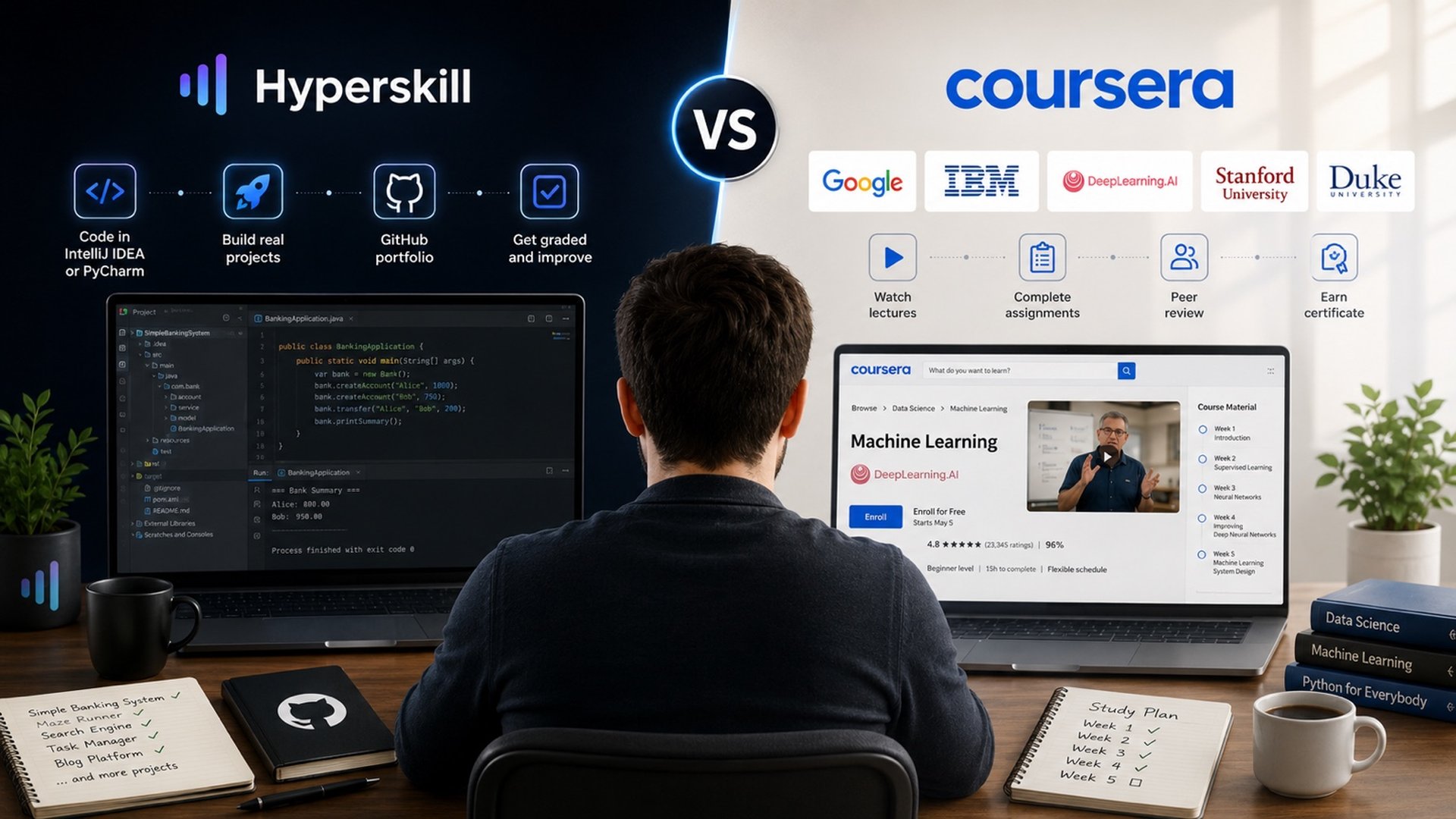
Coursera has built one of the most recognised credential ecosystems in online education: partnerships with Google, IBM, DeepLearning.AI, Duke, Stanford, and dozens of other institutions whose names carry weight in hiring. If institutional credentialing is what you need, Coursera is one of the few platforms that can actually provide it.
Hyperskill, powered by JetBrains, takes a fundamentally different approach. Rather than assembling credentials from partners, it focuses on building practical, deployable skill through a project-first curriculum integrated with professional IDE tooling. The output is not a university-affiliated certificate — it is a GitHub portfolio of real applications, built inside IntelliJ IDEA or PyCharm, that demonstrates what you can actually build.
This comparison focuses on what actually matters for working professionals: how each platform builds skill, what the output of your learning looks like, how each maps onto real hiring contexts, and which one is the better investment depending on your specific situation.
How Each Platform Builds Skill
Hyperskill: practice-first, project-driven
Hyperskill runs on an 80% practice / 20% theory model. The primary activity is building projects — complete, deployable applications — inside IntelliJ IDEA or PyCharm from day one. Theory is available on demand as you build, surfaced when you encounter a concept in context rather than front-loaded before you write any code. This mirrors how professional developers actually learn on the job: by encountering real problems and finding the knowledge needed to solve them.
The platform offers dedicated courses across Java, Kotlin, Python, SQL, and other languages. In the Java Developer course, for instance, you build a progression of real applications — a Simple Banking System, a Maze Runner, a Simple Search Engine — each graded automatically and estimated in real hours. By the end, you have six to ten substantial projects on GitHub. The same model applies across the Java Backend Developer (Spring Boot), Python Developer, Python Backend Developer, and Kotlin Developer courses: the portfolio grows as you learn, not as a separate effort afterward.
The self-paced structure suits working adults who cannot commit to fixed schedules. Hyperskill estimates each project in real hours, so you can plan your learning around your available time rather than hoping a course's pace matches your life.
Coursera: credential-first, lecture-driven
Coursera's model is built around structured video lectures, graded assignments, and peer review, organised into courses and multi-course specialisations. The lecture-first structure means theory precedes practice, and the primary deliverable of completing a course is a certificate from the partner institution: Google, IBM, DeepLearning.AI, a university.
The platform's credential ecosystem is genuinely strong. The Google IT Automation with Python certificate, the IBM Data Science Professional Certificate, and the DeepLearning.AI specialisations are among the most recognised online credentials in their respective fields. For professionals targeting roles where institutional backing matters — data science, ML engineering, certain corporate IT environments — Coursera's credentials carry weight that platform-level certificates cannot replicate.
The practical limitation is portfolio depth. Most Coursera programming assignments are scoped to individual courses rather than structured to produce a body of deployable, end-to-end applications. A professional who completes a Coursera specialisation has a certificate and course-level exercises — but not the kind of GitHub portfolio that a technical interviewer will spend thirty minutes with.
The Portfolio Question
For working professionals, the most practically important difference between Hyperskill and Coursera is what your learning produces.
On Hyperskill, the output of a course is a portfolio. Each project is a complete, independently deployable application — built in a professional IDE, graded for correctness, GitHub-ready. The curriculum and the portfolio are the same activity. By the time you finish a course, you have concrete work to show in a technical conversation or a code review.
On Coursera, the output of a course is a certificate. The portfolio, if you build one, is a separate effort — something you construct alongside or after the coursework using the skills you've acquired. That's not a criticism of Coursera's model, but it is a real difference in what you walk away with. Professionals who complete a Coursera specialisation and don't independently build substantial projects end up with strong credential signalling and a thin body of demonstrable work.
The practical implication: if your next career move depends primarily on demonstrating what you can build — in a technical interview, in a code review, on a GitHub profile — Hyperskill's project-first model produces that evidence directly. If it depends on presenting a credential from a recognised institution, Coursera's partner network is better positioned to provide it.
Head-to-Head: Key Dimensions
Learning format
Hyperskill is project-first. You build from day one, with theory available on demand. The primary activity is writing code that runs, encountering problems, and solving them. For professionals who learn by doing — who find passive lecture consumption slow and frustrating — this format is significantly more effective.
Coursera is lecture-first. You watch, read, complete exercises, and then apply. For professionals who prefer structured explanation before attempting practice — or who are studying a domain where conceptual grounding is essential before practical work, such as machine learning theory — the lecture-first structure is appropriate.
IDE and tooling
Hyperskill integrates IntelliJ IDEA and PyCharm directly into the learning experience. You code in the same professional environment you will use on the job. The IDE's code intelligence, inspections, and refactoring tools are available throughout, which means you develop professional toolchain fluency as a natural part of learning the language. There is no transition between learning environment and professional environment — they are the same.
Coursera courses typically use browser-based coding environments, Jupyter notebooks, or ask learners to configure local environments independently. For professionals who are already comfortable with their development environment, this is manageable. For those learning their first professional IDE alongside a new language, it adds friction that Hyperskill's integrated approach avoids.
Certifications and credentials
Hyperskill issues its own certificates upon course completion. These carry genuine recognition in hiring contexts where the JetBrains brand is known — primarily Java, Kotlin, and Python development roles. They are platform-level credentials, not university-affiliated, and their primary signal value is that completion requires demonstrated project work rather than just course attendance.
Coursera issues certificates from partner institutions: Google, IBM, Meta, Stanford, DeepLearning.AI, and others. These carry institutional weight that is particularly relevant in data science, ML, and certain corporate IT hiring pipelines where a Google or IBM credential is specifically recognised. For professionals where that institutional association matters to a hiring decision, Coursera's credential ecosystem is a genuine differentiator.
Pricing
Hyperskill operates on a freemium model. The free tier provides access to a meaningful portion of content, with full access to all project-based courses available on a paid subscription. The projects are where the learning happens, so the paid plan is where the platform's real value lies.
Coursera operates on a freemium model: individual courses can be audited for free, but audit access typically excludes graded assignments and certificates. Full specialisation access requires a Coursera Plus subscription or per-course payment. Coursera Plus, which includes a 7-day free trial, provides access to most of the catalog for a monthly fee and can be cost-effective for professionals planning to complete multiple courses in a short period.
Self-paced flexibility
Both platforms offer self-paced learning, but the experience differs in practice. Hyperskill's project-based structure is fully flexible — you work at your own pace, with real-hour estimates that help you plan. Coursera's self-paced mode works well for independent learners but some specialisations have cohort-based elements or recommended weekly schedules that can feel at odds with a professional's irregular availability.
Side-by-Side Comparison
Hyperskill
Coursera
Learning model
80% practice, 20% theory — projects first
Lecture-first, exercises secondary
IDE integration
✓ IntelliJ IDEA / PyCharm from day one
✗ Browser-based or local setup on learner
Portfolio output
✓ 6–10 deployable projects per course
⚠ Thin without extra independent work
Certification
Hyperskill certificate
University / company-backed specializations
Credential recognition
Strong for project-focused hiring
Strong for institutional / credential-focused hiring
Languages covered
Java, Kotlin, Python, SQL, and more
Python, Java, data science, ML, and more
Pricing
Freemium; paid subscription for full access
Freemium; Coursera Plus subscription
Self-paced
✓ Fully self-paced
⚠ Self-paced but cohort deadlines on some courses
Best for
Professionals building deployable skills and a portfolio
Professionals needing institutional credentials for specific roles
Which Platform for Which Situation
Choose Hyperskill if:
Your primary goal is deployable skill and a portfolio of real projects. You are a working developer adding a language — Java, Kotlin, or Python — to your stack and need to reach professional competency efficiently. You want to work in IntelliJ IDEA or PyCharm from day one rather than transitioning from a browser sandbox later. You are a near-technical professional switching into development and need a structured curriculum that produces portfolio-ready projects as its direct output. You learn best by building, and passive video consumption feels slow and unproductive.
Choose Coursera if:
You need a credential from a specific institutional partner — Google, IBM, DeepLearning.AI — for a hiring context where that institutional association is specifically valued. You are entering data science or ML and the IBM or DeepLearning.AI specialisations align directly with your target role. You prefer structured conceptual grounding before hands-on practice, and the lecture-first format suits how you learn. You are already disciplined about building independent portfolio projects and need the credential rather than the portfolio structure.
Consider both if:
Your goal is to maximise both credential signalling and practical portfolio depth. A Coursera specialisation for institutional credential value combined with Hyperskill for project-based skill development is a coherent strategy for professionals who need both — particularly those targeting roles where a Google or IBM data science certificate is relevant and where a GitHub portfolio of backend projects is also expected.
FAQ
Is Hyperskill or Coursera better for learning Java in 2026?
For professional Java development, Hyperskill is the stronger choice. Its Java courses are built around real projects inside IntelliJ IDEA — the IDE that most Java developers use professionally — and the curriculum produces a GitHub portfolio of deployable applications as a direct output. Coursera's Java content is less comprehensive and not anchored by a credential from a partner with Java-specific authority. For learning Java with the goal of working as a Java developer, Hyperskill's project-first model and IDE integration are the most directly relevant combination available.
Is Hyperskill or Coursera better for learning Python?
It depends on your target. For Python backend development — Django, FastAPI, building deployable services — Hyperskill's Python Backend Developer course, built around real projects inside PyCharm, is the stronger option. For data science and machine learning, where the IBM Data Science Professional Certificate or DeepLearning.AI specialisations carry specific hiring weight, Coursera has a genuine advantage in credential value. Professionals targeting data roles who also need backend Python skills may benefit from both platforms used in combination.
Does Coursera's certificate carry more weight than Hyperskill's?
In contexts where institutional affiliation is specifically valued — particularly data science and ML hiring where Google, IBM, or DeepLearning.AI credentials are recognised — yes, Coursera's partner certificates carry more institutional weight. In contexts where technical evaluation is project-based — where interviewers review your code and ask you to walk through what you built — Hyperskill's certificate, backed by demonstrated project work, is more directly relevant. Neither is universally superior; the question is which credential matters in your specific hiring context.
Can I use Hyperskill and Coursera together?
Yes, and for some professionals this is the most effective approach. Coursera for institutional credential value in a specific domain; Hyperskill for project-based skill development and portfolio building. The two platforms address different gaps: Coursera answers "what credentials do I have?" and Hyperskill answers "what can I build?" Both questions matter in most technical hiring processes.
How does the pricing compare in practice?
Both platforms operate on a freemium model, with full access to their most valuable content requiring a paid subscription — Hyperskill for the full project catalog, Coursera for graded assignments and certificates. Coursera's free audit tier provides access to video lectures but not assessments; Hyperskill's free tier gives meaningful access to content with the paid plan unlocking the complete project curriculum. Coursera Plus's 7-day trial makes it possible to complete shorter specialisations at low cost for focused learners; Hyperskill's subscription is better suited to professionals planning extended, structured learning across a full course.
Which platform is better for a career switcher?
Hyperskill is the stronger choice for near-technical professionals switching into software development. The project-first model builds the portfolio that technical hiring processes actually evaluate, the IDE integration closes the professional tooling gap, and the structured curriculum addresses the specific learning needs of professionals who have technical context but need deployable coding skill. Coursera is a better fit for career switchers specifically targeting data science or ML roles where institutional credentials — particularly from IBM or DeepLearning.AI — carry meaningful hiring weight.
The Verdict
Hyperskill and Coursera are both legitimate, well-built platforms. The choice between them is not about which is better in absolute terms — it is about which model produces the outcome you actually need.
If you are a working professional who needs to build deployable skill, reach professional competency in Java, Kotlin, or Python, and produce a portfolio that holds up in a technical evaluation — Hyperskill's project-first, IDE-integrated model is the more direct path. The portfolio is the output of the curriculum, not a separate project you undertake after finishing it.
If you need a credential from a specific institutional partner — particularly for data science or ML roles where Google, IBM, or DeepLearning.AI certifications are specifically valued — Coursera's partner network is the right tool for that specific job.
For most working professionals whose goal is to become a more capable, more employable developer — not just a more credentialled one — Hyperskill is the better investment.
Hyperskill vs Coursera in 2026: compare project-based learning, professional certificates, Java and Python courses, coding portfolios, software development skills, and career growth opportunities for working professionals.


like this
Create a free account to access the full topic


