

Hyperskill vs Codecademy: Which Is Worth Your Time as a Professional Developer

Introduction
Codecademy has introduced more people to programming than almost any other platform. Its browser-based, guided, interactive format removes every barrier between a curious person and their first line of code — no environment setup, no configuration, no blank screen to stare at. For absolute beginners, that friction removal is genuinely valuable.
The question this article is not asking is whether Codecademy is good for beginners. It is. The question is whether Codecademy is worth your time as a working professional — a developer, a QA engineer, a data analyst, a technical professional who needs to build or expand real coding skills and needs those skills to hold up in a professional environment. That is a different question, and the answer is different.
Hyperskill, powered by JetBrains, is built for exactly that context: professionals who need to build production-relevant skills, work in real IDE tooling, and produce a GitHub portfolio of deployable applications. This comparison examines where each platform delivers value, where each falls short, and which one is the better investment of a working professional's limited learning time.
How Each Platform Builds Skill
Hyperskill: real projects, real tooling, real outcomes
Hyperskill runs on an 80% practice / 20% theory model. From the moment you start a course, you are building — complete, independently deployable applications inside IntelliJ IDEA or PyCharm, with automatic grading and real-hour estimates per project. Theory is available on demand when you encounter a concept in context, not front-loaded as a prerequisite to touching code.
The platform offers structured courses across Java, Kotlin, and Python for different professional goals. The Java Developer course takes you through a sequence of real applications — a Simple Banking System, a Maze Runner, a Simple Search Engine — each graded automatically and GitHub-ready on completion. The Java Backend Developer (Spring Boot), Python Backend Developer, and Kotlin Developer courses follow the same structure. By the end of a course, you have six to ten substantial, independently built projects on GitHub. The portfolio is the curriculum — not a separate effort that follows it.
Working inside IntelliJ IDEA or PyCharm throughout means professional toolchain fluency is a byproduct of the learning. You develop the habits — version control, dependency management, IDE-assisted refactoring — that distinguish a professional developer from someone who has completed online exercises.
Codecademy: guided exercises, browser sandbox, scaffolded completion
Codecademy's model is built around interactivity and guidance. Exercises are presented in a browser-based environment that provides instant feedback — write a line of code, see the result, move to the next step. The platform's Career Paths structure multiple courses into a learning sequence for specific roles, and the Pro subscription adds guided projects that apply the concepts covered in each section.
The fundamental characteristic of Codecademy's approach is that every step is scaffolded. The environment tells you what to write next. If you get stuck, hints are available. If you make an error, the feedback is immediate and specific. This structure is effective for reducing the frustration of early learning and for keeping beginners moving through material that would otherwise feel overwhelming.
The limitation — and it is a significant one for professional development — is that scaffolding removes exactly the cognitive challenge that builds real competency. Working through a problem without knowing the answer, forming a hypothesis, testing it, and iterating when it fails: this is how professional developers actually work, and it is the skill that technical interviews are designed to assess. Codecademy's guided model builds familiarity with syntax and concepts; it does not build the independent problem-solving capability that professional work requires.
The Scaffolding Problem
This is the central issue with Codecademy for professional developers, and it deserves direct attention.
Scaffolded learning — where the next step is always provided, hints are available, and the environment catches every error immediately — creates what learning researchers call "illusions of competence." You complete exercises successfully and feel productive. The material feels manageable. Progress feels real. And then you open a blank file in an IDE and try to build something from scratch, and the scaffolding is gone — and so, it turns out, is a significant portion of what felt like learned skill.
This is not a theoretical concern. It is the most common complaint from developers who have spent significant time on Codecademy and then attempted technical assessments: the ability to complete guided exercises does not translate into the ability to build independently. The gap surfaces immediately in any context where the environment does not tell you what to do next — which is every professional context.
Hyperskill is structured to avoid this problem by design. Projects are built independently — you are given a specification and a grading system, and you build the solution yourself inside IntelliJ IDEA or PyCharm. There is no step-by-step guidance, no in-environment hints for the project itself. The discomfort of working through problems without scaffolding is present from day one, because it is the only way to develop the capability that professional work actually requires.
Depth: Where Codecademy Ends and Professional Work Begins
Codecademy covers fundamentals well. Syntax, basic data structures, control flow, introductory object-oriented concepts, simple functions — these are covered thoroughly and accessibly. For someone who has never written code, the platform provides a well-designed on-ramp.
The depth limitation becomes apparent when you look at what professional development work actually requires. Production Java development means Spring Boot, Maven or Gradle, JPA, REST API design, proper exception handling, testing with JUnit. Production Python development means Django or FastAPI, virtual environment management, type hints, database integration, proper project structure. Production Kotlin development means coroutines, extension functions, data classes, Ktor or Spring Boot with Kotlin.
Codecademy does not cover these topics with meaningful depth. Its Java content covers language fundamentals. Its Python content covers syntax and basic programming concepts. Advanced topics — the frameworks, the tooling, the production patterns — are either absent or covered at an introductory level that does not prepare a developer for professional use. A developer who has completed Codecademy's Python Career Path is not prepared to contribute to a Python backend codebase using FastAPI and SQLAlchemy. The gap between what Codecademy covers and what production work requires is substantial.
Hyperskill covers the full range. The Java Backend Developer (Spring Boot) course builds to production-relevant Spring Boot applications with real databases. The Python Backend Developer course covers Django and FastAPI with proper tooling and project structure. The Kotlin Developer course covers coroutines, idiomatic patterns, and Ktor backend development. These are not introductory overviews — they are the skills that the job market for these roles actually demands.
The IDE Gap
Professional software development happens in professional IDEs. IntelliJ IDEA for Java and Kotlin. PyCharm for Python. VS Code for JavaScript. The code intelligence, refactoring tools, debugger, and project management capabilities that these environments provide are not optional features — they are the tools that professional developers use daily, and fluency with them is a baseline expectation in most development roles.
Codecademy's browser-based environment is explicitly designed to avoid the friction of local IDE setup. That is appropriate for beginners who have not yet decided whether programming is something they want to pursue. For working professionals, it is a significant limitation: the skills you build in a browser sandbox do not automatically transfer to a professional development environment. The first time you clone a repository, configure a project, and set up a run configuration in IntelliJ IDEA after months of browser-based learning, the environment feels entirely foreign.
Hyperskill integrates IntelliJ IDEA and PyCharm directly into the learning experience from day one. You never learn in a browser sandbox and then transition to a professional environment — you build in the professional environment throughout. By the time you complete a course, working in IntelliJ or PyCharm is not a new skill you need to acquire; it is already months of accumulated practice. That distinction matters significantly in the first weeks of a new role or a technical assessment.
Head-to-Head: Key Dimensions
Project independence
Hyperskill requires you to build projects independently. You receive a specification and a grading system. The solution is yours to develop, inside a professional IDE, without step-by-step guidance. The automatic grading system evaluates correctness and provides feedback, but the cognitive work of building the solution — decomposing the problem, structuring the code, handling edge cases — is entirely your own. This is the model that builds the problem-solving capability that professional work requires.
Codecademy guides every step. Its guided projects provide a structure where each task is specified, hints are available, and the environment validates each step as you go. This produces a sense of completion and progress that is motivating for beginners. For professionals, it produces the illusion of competency without the underlying capability — because the moment the scaffolding is removed, the skill does not transfer cleanly.
Coverage depth
Hyperskill covers the full professional stack for its supported languages. Java: from fundamentals through Spring Boot, JPA, REST APIs, and testing. Python: from fundamentals through Django, FastAPI, pandas, and data engineering. Kotlin: from language fundamentals through coroutines, idiomatic patterns, and Ktor. These are the skills that development roles in these languages actually require.
Codecademy covers fundamentals and introductory career path content. Its depth is appropriate for someone building initial familiarity — it will not leave gaps in your understanding of basic syntax or control flow. It will leave significant gaps in your understanding of production frameworks, professional tooling, and the architectural patterns that senior developers evaluate in technical interviews.
Portfolio output
Hyperskill produces a portfolio as the direct output of its curriculum. Each course generates six to ten complete, independently built, GitHub-ready applications. These are projects you can open in a technical conversation, walk through the architecture, explain the decisions, and discuss the trade-offs. The portfolio is not separate from the learning — it is the learning.
Codecademy produces guided projects that are technically on your profile but do not function as independent portfolio work. A reviewer examining a Codecademy guided project knows that every step was specified and that the developer followed instructions rather than building independently. These projects do not answer the question a technical interviewer is asking: can this person build something without being told what to do?
Pricing
Hyperskill operates on a freemium model. The free tier provides access to meaningful content; full access to the complete project-based curriculum requires a paid subscription. Given that the projects are where the platform's real value lies, the paid plan is where the meaningful learning happens.
Codecademy also operates on a freemium model. The free tier covers basic course content; the Pro subscription adds guided projects, quizzes, and certificate of completion. Codecademy Pro is priced accessibly, and the free tier covers more substantive content than Hyperskill's free tier. The constraint is not access — it is depth and the scaffolding model, which apply regardless of plan.
Side-by-Side Comparison
Hyperskill
Codecademy
Learning model
80% practice, 20% theory — real projects
Interactive exercises — guided, browser-based
IDE integration
✓ IntelliJ IDEA / PyCharm from day one
✗ Browser sandbox throughout
Project independence
✓ Built independently, automatically graded
✗ Every step scaffolded and guided
Portfolio output
✓ 6–10 deployable projects per course
⚠ Guided projects, not independently built
Depth of coverage
Production-relevant: frameworks, tooling, architecture
Fundamentals and intro-level career paths
Advanced topics
✓ Spring Boot, Ktor, Django, FastAPI, coroutines
✗ Limited advanced coverage
Certification
Hyperskill certificate
Completion certificate only
Pricing
Freemium; paid subscription for full access
Freemium; Pro subscription
Self-paced
✓ Fully self-paced with hour estimates
✓ Fully self-paced
Best for
Professionals building real skills and a portfolio
Absolute beginners learning syntax fundamentals
Which Platform for Which Situation
Choose Hyperskill if:
You are a working professional who needs to build real, production-relevant coding skills. You are a developer adding a new language — Java, Kotlin, or Python — to your professional stack and need to reach genuine competency, not just familiarity. You are a near-technical professional — a QA engineer, data analyst, technical support specialist — switching into development and need a curriculum that produces a real portfolio as its output. You need to work in IntelliJ IDEA or PyCharm professionally and want to develop that fluency as part of learning the language. You learn best by building independently and find guided, scaffolded exercises insufficient preparation for real work.
Codecademy is worth considering if:
You are completely new to programming and want to test whether coding is something you want to pursue before committing time to a more demanding platform. The low friction of Codecademy's browser-based environment and guided model makes it a reasonable first step for absolute beginners. If you determine that development is a direction you want to pursue professionally, the next step is a platform that builds the independent, production-relevant skills that Codecademy's model does not develop.
The progression that actually makes sense:
For professionals who have used Codecademy as an introduction and want to move to genuine professional competency, the path is clear: move to a project-first platform that requires independent building in professional tooling. Codecademy can serve as a syntax introduction; it cannot serve as a professional development curriculum. The skills that matter in a technical evaluation — independent problem-solving, production framework knowledge, professional tooling fluency — require a different learning model.
FAQ
Is Codecademy enough to become a professional developer?
No, not on its own. Codecademy covers language fundamentals and introductory concepts effectively, but it does not build the production framework knowledge, IDE fluency, or independent problem-solving capability that professional development roles require. Developers who have relied primarily on Codecademy consistently find that their skills do not transfer cleanly to professional environments or technical assessments. It is a useful starting point; it is not a sufficient endpoint for professional competency.
Can Codecademy projects be used in a professional portfolio?
Codecademy's guided projects are not strong portfolio assets for professional roles. Technical reviewers can identify guided projects immediately — every step was specified, the developer followed instructions, and the code structure matches the guided path rather than reflecting independent architectural decisions. A portfolio of Codecademy guided projects signals that you have worked through a structured curriculum; it does not signal that you can build something independently. For a professional portfolio, independently built projects — built outside a guided environment, from a specification to a working solution — are what actually carry weight.
Is Hyperskill harder than Codecademy?
Yes, in the sense that matters: Hyperskill requires you to build independently, without scaffolding, from early in the curriculum. That is harder than following guided steps in a browser environment. It is also why Hyperskill produces a meaningfully different outcome — the difficulty of working through problems independently is exactly what builds the capability that professional work requires. The discomfort of not knowing what to do next, and having to figure it out, is not a design flaw; it is the mechanism by which real competency develops.
Which platform is better for a QA engineer switching to development?
Hyperskill is significantly better for this transition. A QA engineer switching to development needs to build independently, work in professional IDE tooling, and produce a portfolio that demonstrates coding competency. Codecademy's guided model does not develop the independence that technical interviews test for, its coverage does not reach the production frameworks that development roles require, and its browser-based environment does not prepare you for IntelliJ IDEA or PyCharm. Hyperskill's Java or Python courses, built around independent projects inside professional tooling, produce exactly the combination of skills and portfolio work that this transition requires.
How does Codecademy's Career Path compare to Hyperskill's courses?
Codecademy's Career Paths structure multiple courses into a learning sequence for a specific role — Python Developer, Data Scientist, Back-End Engineer. They provide more structure than individual Codecademy courses and cover more ground. The fundamental limitations remain: the guided, scaffolded model does not build independent problem-solving, the browser-based environment does not develop professional IDE fluency, and the depth does not reach the production frameworks and tooling that the job market for these roles actually requires. Hyperskill's courses are structured around the same goal — role-specific professional competency — but with a model that produces production-relevant skills and portfolio output rather than guided exercise completion.
What should I do if I've already spent time on Codecademy?
The time was not wasted if it built initial familiarity with syntax and basic programming concepts — that foundation is real, even if it is incomplete. The next step is to move to a platform that builds on that foundation with independent project work in professional tooling. Starting a Hyperskill course after Codecademy means you will progress through the early fundamentals faster than someone starting from zero — the conceptual grounding is already there. What you are building now is the independent problem-solving capability, the production framework knowledge, and the portfolio of deployable projects that professional roles actually require.
The Verdict
Codecademy is a well-designed platform for what it does: introducing absolute beginners to programming in a low-friction, guided environment. It lowers the barrier to entry for people who have never written code, and for that purpose it is genuinely good. It is not, however, a professional development platform — and treating it as one is the most common and most costly mistake that near-technical professionals make when planning a transition into development.
The scaffolding that makes Codecademy accessible to beginners is exactly what makes it insufficient for professionals. The browser sandbox that removes setup friction is exactly what leaves you unprepared for a real development environment. The guided projects that feel productive are exactly what reviewers discount in a portfolio evaluation. These are not incidental limitations — they are structural features of a platform designed for a different audience than working professionals.
Hyperskill is designed for the audience this article is written for: professionals who need to build real, production-relevant skills, work in professional tooling, and demonstrate independent competency in a technical evaluation. The 80/20 practice-theory model, the independent project building inside IntelliJ IDEA and PyCharm, the GitHub-ready portfolio output, and the production framework coverage collectively produce an outcome that Codecademy's model is not structured to deliver.
If your goal is professional competency in Java, Kotlin, or Python — not introductory familiarity, but the ability to contribute to a production codebase and hold your own in a technical interview — Hyperskill is where that goal is achievable. Codecademy is where the journey often starts. It is not where it ends.
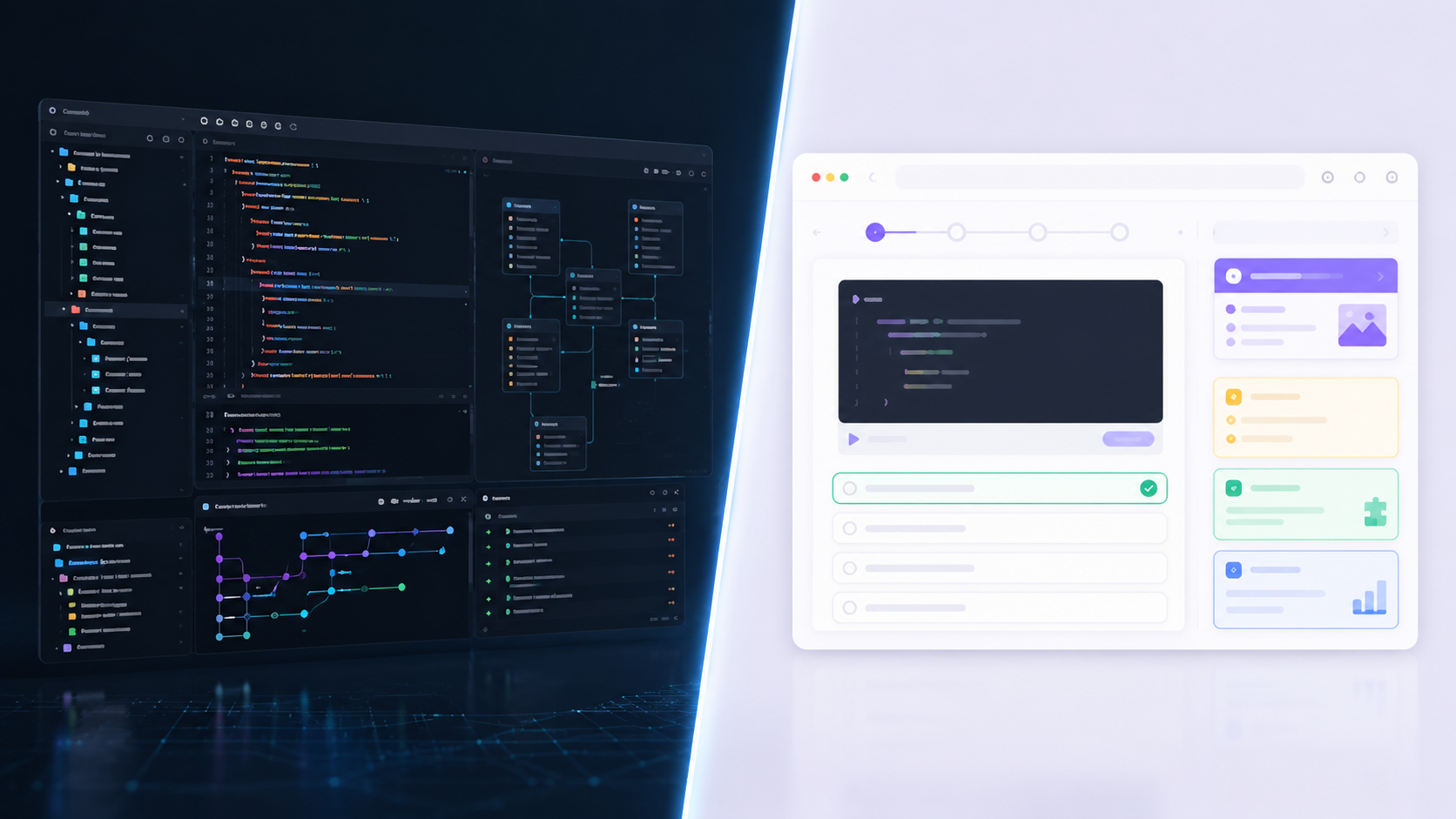
Codecademy makes it easy to learn programming fundamentals. Hyperskill is designed to help developers build production-ready skills through real projects and professional tooling. This comparison explores how the two platforms differ in project work, portfolio development, IDE experience, framework depth, and preparation for real development roles.


like this
Create a free account to access the full topic


