

Which Java Skills and Frameworks Are Most in Demand for 2026 and Beyond

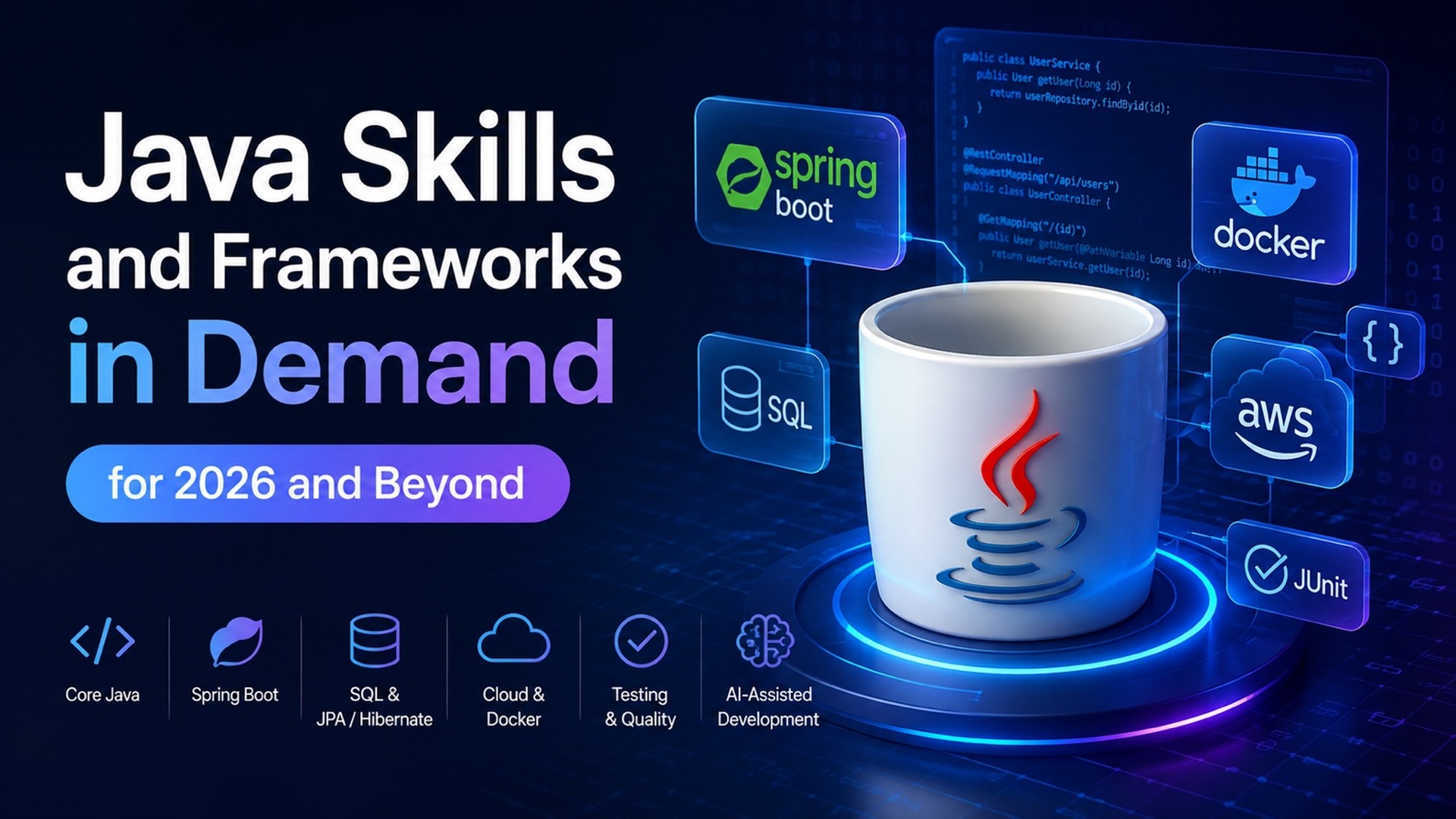
Wondering which Java-related skills and frameworks are most in demand for 2026 and beyond? This guide gives you a sourced answer, so you can spend your study time where employers actually hire. You will see the in-demand Java skills, the frameworks, the tools, and the habits that turn intermediate developers into job-ready ones.
Is Java Still in Demand in 2026?
Yes. Java is still in high demand in 2026, especially for enterprise backend systems and cloud services. Large companies rely on it for software that has to run for years, so they keep hiring people who know it well.
Java ranks #4 on the TIOBE Index with a rating of 8.03% as of July 2026. That index tracks how often a language is searched for online, so it measures interest more than production use.
Actual usage tells a similar story. In the Stack Overflow Developer Survey 2025, 29.4% of all respondents reported using Java. That keeps it among the languages teams build on every day.
What Makes a Java Skill "In Demand"
A skill is in demand when employers hire for it and when modern systems are built with it. Those two forces decide where your learning time pays off.
It helps to split Java skills into two groups. Core language skills are the fundamentals you use in every program. Framework and ecosystem skills are the libraries teams add on top to ship real applications faster.
The best way to prove any of these is to build with them. A skill you have used in a working project carries more weight than one you only read about.
Which Java-Related Skills and Frameworks Are Most in Demand for 2026
The in-demand Java skills below show up again and again in job posts. We will start with the fundamentals, then move to the modern features and tools that mid-level roles expect.
Strong Core Java Fundamentals
Core Java is the base every employer assumes you have. It starts with object-oriented programming, the way Java organizes code into objects that hold both data and behavior.
You also need data structures and collections for storing and moving data, plus exception handling for errors. Concurrency and thread safety come next, so your programs can do more than one thing at once without corrupting data.
Almost every skill guide lists these, and for good reason. Skip them and nothing else will stick.
If you are starting from zero, a project-based course like Introduction to Java builds these fundamentals through code you write yourself.
Modern Java Features (Java 17 and Java 21)
Employers increasingly expect you to know recent Java versions. Java 17 and Java 21 are long-term support (LTS) releases, which means they get years of updates and are safe for companies to build on.
These versions add features that make code shorter and clearer. Records cut boilerplate for data classes, and sealed classes limit how a type can be extended. Pattern matching simplifies conditional logic, and virtual threads make it easier to handle many tasks at once.
This migration is happening right now. The New Relic 2024 State of the Java Ecosystem found that 35% of monitored applications ran on Java 17 in 2024, up from 9% in 2023. New Relic also reported that Java 21 was adopted about 287% faster than Java 17 early on.
To go deeper into concurrency and modern language features, the Advanced Java course walks through them with hands-on projects.
Databases and Persistence (SQL, JPA, Hibernate)
Nearly every backend role involves storing and reading data, so database skills are close to mandatory. SQL is the language you use to query relational databases directly.
JPA and Hibernate let you map Java objects to database tables, so you work with objects instead of raw SQL for common tasks. Knowing both the raw queries and the mapping tools makes you far more useful on a team.
Databases are a weak spot in many skill guides, so learning them sets you apart. A course like SQL for backend developers gives you query practice on realistic data.
REST APIs and Microservices
A REST API is a standard way for programs to talk to each other over the web. Backend developers build these APIs so apps and other services can request and send data.
Microservices break a large system into smaller, independent services that each do one job. Big companies structure work this way because small teams can build and deploy their piece without waiting on everyone else.
Java is a common choice here. The JetBrains The State of Java 2025 survey found that 46% of the Java developers surveyed named Java as their top language for microservices.
Cloud, Docker, and Deployment
Writing code is only half the job. Teams also need that code running reliably in production, which is where deployment skills come in.
Docker packages an app and everything it needs into a container that runs the same way on any machine. From there, developers deploy to cloud platforms such as AWS and Azure.
Key point: knowing how to containerize and deploy a Java app is often what separates a junior developer from a mid-level one.
Testing and Quality (JUnit, TDD)
Professional teams expect your code to come with tests. JUnit is the standard tool for writing unit tests in Java, which check that small pieces of your code work as intended.
Test-driven development (TDD) takes this further. You write the test first, then write just enough code to pass it. This habit catches bugs early and gives teammates confidence in your changes.
Hyperskill leans on this idea while you learn. Your project code runs against automated tests and code-quality checks, so you get feedback the way a real team would give it.
The Java Frameworks Worth Learning in 2026
A framework is a ready-made structure of code that handles common tasks for you, so you write less from scratch. Among the in-demand Java-related skills, frameworks concentrate hiring, because once a company standardizes on one, it hires people who already know it.
Spring and Spring Boot: The Backend Standard
Spring is the default framework for Java backend work, and Spring Boot is the part that makes it fast to start. Spring Boot gives you auto-configuration and an embedded web server out of the box. It also handles dependency injection, so your app runs with very little setup.
Spring's lead is clear in the data. JetBrains The State of Java 2025 found that Spring is the leading web framework, used by 65% of the Java developers surveyed.
If you want to build this skill end to end, the Java Backend Developer (Spring Boot) course has you ship a working backend through real projects.
Spring Security and Application Safety
Security is a strong hiring signal, because a single bug here can expose user data. Spring Security is the standard way to add protection to a Spring application.
It handles authentication, which confirms who a user is, and authorization, which decides what that user can do. Role-based access control then lets you grant different permissions to admins and regular users.
You learn this best by building it. A set of Spring Security projects lets you add login and access control to a real app.
Beyond Spring: Emerging Frameworks
Spring is not the only option. Quarkus and Micronaut are newer frameworks built for cloud-native and reactive apps, and they aim for faster startup and lower memory use.
They hold a smaller share than Spring today, so treat them as useful extras once your Spring skills are solid. They are worth watching, though they should not be your first stop.
The Tools and Environment That Signal a Professional
Employers notice the tools you are comfortable in. Knowing the standard Java toolchain shows you can work the way real teams do from day one.
A professional IDE is the center of your workflow. IntelliJ IDEA is the most common one for Java. The JetBrains The State of Java 2025 survey found it was used by 72% of the Java developers surveyed.
Build tools like Maven and Gradle manage your project's dependencies and compile your code. Git handles version control, so you can track changes and work alongside other developers.
Hyperskill learners practice inside the same JetBrains IDEs used in industry. The environment you learn in matches the one you will work in.
How AI Is Changing Java Development
AI coding assistants are now part of everyday development. They can suggest code, explain errors, draft tests, and answer quick questions, which speeds up routine work.
Adoption is broad across the industry. The JetBrains State of Developer Ecosystem 2024 reported that about 80% of developer organizations permit AI tools or have no policy against them. JetBrains also found that 49% of developers regularly use ChatGPT for coding.
These figures cover developers across languages, not Java alone.
For Java developers, this raises the value of fundamentals. You still need to review and fix the code an assistant produces, and that takes real understanding.
The Java Job Market and Career Outlook
Java skills open a wide set of roles, including backend, full stack, Android, and enterprise development. Demand for developers overall stays strong, which keeps these roles well paid.
Government data backs this up for the wider field. The U.S. Bureau of Labor Statistics projects employment of software developers to grow 15 percent from 2024 to 2034. The Bureau of Labor Statistics also reports a median wage of $133,080 for software developers as of May 2024.
These numbers cover all software developers, not Java roles specifically. Java is a large part of that market, so the trend applies to Java careers too.
How to Build These Java Skills the Right Way
You do not build these skills by reading alone. You build them by writing real code and fixing what breaks along the way.
A practical path moves from core Java fundamentals to a Spring Boot backend, with a portfolio of projects at the end. Each project becomes proof you can show an employer. Hyperskill builds every course this way, at 80% practice and 20% theory. More than 100 companies use it to train their teams, and its graduates have gone on to roles at Nokia, Apple, Tesla, and Dell.
For ideas at any stage, browse Java projects for all levels and pick one that stretches you a little. When you are ready to commit to a track, the full set of backend learning paths maps these skills into an ordered plan.
The demand is real, and the path is clear. Start small, stay consistent, and let your projects prove your skills. Start for free.
Frequently Asked Questions
Is Java Still Worth Learning in 2026?
Yes. Enterprises keep building on Java for long-lived backend systems, and its steady usage in developer surveys means those skills stay employable.
What Is the Most In-Demand Java Framework?
Spring, with Spring Boot, is the most in-demand Java framework, and developer surveys show it leads web framework use among Java developers.
What Are the Most In-Demand Java Skills for 2026?
The core set includes strong Java fundamentals, Spring Boot, REST APIs and microservices, databases, cloud and Docker, plus testing.
How Long Does It Take to Learn Java and Spring Boot?
With consistent, project-based practice, most learners reach job-relevant Java and Spring Boot skills in about three to six months.
Is Java Better Than Python in 2026?
They have different strengths: Java leads enterprise and backend work, while Python leads AI and data. Both stay in high demand.
Discover the most in-demand Java skills and Java frameworks for 2026, including Core Java, Spring Boot, REST APIs, SQL, Hibernate, Docker, cloud computing, testing, and AI-assisted development. Based on industry reports and developer surveys, this guide explains what Java developers need to learn to stay competitive, build real-world projects, and prepare for backend developer jobs in today’s market.


like this
Create a free account to access the full topic


