

Learning AI Engineering While Working a Full-Time React Developer: Story from Gabriel Porras

If you're considering a similar transition, Hyperskill is currently running a special offer for the upcoming AI Engineering bootcamps. Details here: https://go.hyperskill.org/ai-engineer
Why Gabriel Joined a Bootcamp
Gabriel wanted to build a few projects that would force him to work through the full implementation cycle: data handling, model integration, deployment. This way, he could see where his existing development experience transferred and where it didn't. The bootcamp's project structure gave him that: Gabriel ended up with a few GitHub repos he could point to and got a better sense of what he still needed to learn.
"The pacing was clear: module timelines were defined, and the guidance made it easy to know exactly what to do next."
When you're learning something adjacent to your current work but not directly applicable to your day job, having a clear path helps. You don't want to spend your limited time deciding what to learn next or second-guessing whether you're covering the right material.
Full-Stack Development Experience vs AI Engineering
Gabriel found that his full-stack experience gave him a decent foundation for understanding how AI systems fit into applications, but the actual applied AI engineering work, such as data pipelines, model selection, evaluation, was different enough that he couldn't just figure it out on the fly. The bootcamp filled in those gaps in a way that felt more efficient than piecing it together from documentation, Youtube videos, blog posts or even courses.
One thing that stuck with him was the micro-learning approach the bootcamp used. He's now creating his own micro-learning app that uses AI to help structure the content.
"I loved learning about micro-learning at Hyperskill. The whole week approach with small, digestible lessons really works."
Gabriel picked up ideas about how to structure learning itself, which he's now applying to his own project. Gabriel is creating the micro-learning app that sends users a single question via email each day, enabling small, focused learning sessions that support steady progress.
Balancing Work and Learning
Gabriel started the bootcamp in October. He completed about half of the curriculum before having to slow down in December as work got busy. His advice to anyone considering it:
"The main advice is to have the discipline to study every day: half an hour, one hour. But this is the best way to complete and really learn."
Even at 50% completion, Gabriel feels he has enough material to confidently make his next career move. The curriculum gave him a roadmap and a lot of reference material he's still working through. For someone with a full-time developer job, that's probably one of the realistic outcomes: you get structure and lifetime materials that you can come back to any time.
What's Next
Gabriel plans to apply for AI engineering roles this year, keeping in mind what he's already capable of, what the role involves and what he'd need to demonstrate in interviews. The bootcamp gave him a structured way to learn the technical fundamentals, a few projects to work through the implementation details and a sense of whether this is a direction he wants to pursue.
Should You Consider This Path?
If you're an experienced developer wondering whether AI engineering is a realistic next step, Gabriel's experience suggests it's doable if you're willing to put in consistent time. The bootcamp isn't a shortcut but structured learning that assumes you'll do the work while providing support along the way. If you want to understand how AI systems are built rather than just using them as tools, and you prefer having a clear curriculum over piecing things together yourself, it's worth considering.
The main constraint is time. If you're working full-time, expect to spend at least 30-60 minutes daily to make real progress, or 10-12 hours weekly. Still, if you can't commit consistently, you'll get value from the studies: you can finish on your own in self-paced mode. For this, the program includes a 1-year Hyperskill subscription and lifetime access to materials.
If you're at the point where you want to stop wondering and start building, there's currently a special offer available for the upcoming bootcamps. You can learn more here: https://go.hyperskill.org/ai-engineer
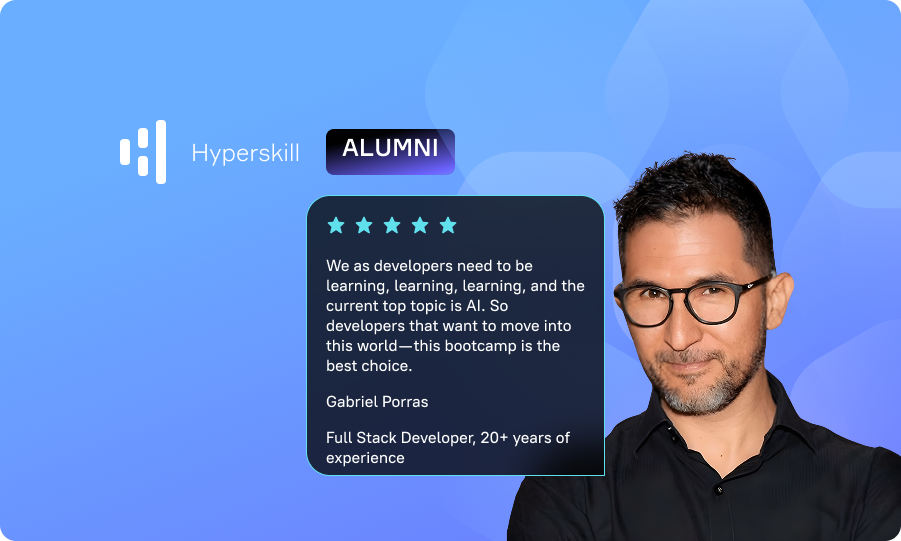
Gabriel Porras (Linkedin) with 20+ years of overall experience, has spent several years working as a full-stack developer, with a strong focus on React frontends for US companies, while working remotely from Colombia. He used AI tools here and there — ChatGPT for planning, Claude Code for coding — but wanted to understand how things work under the hood. That’s why he joined the Hyperskill AI Engineering Bootcamp: to see whether moving from full-stack engineering to AI engineering was realistic and where the real skill gaps were. Gabriel finished about half of the program before work got intense, and now continues at his own pace. Even with 50% done, he walked away with a clear picture of what AI engineering involves and the confidence that this transition is possible without starting from zero.


like this
Create a free account to access the full topic


