

How to Add a New Programming Language to Your Stack: What Actually Works

Introduction
Most working developers will add at least one new language to their stack during their career — not because they chose to, but because the job required it. A Java backend engineer joining a team that's migrating to Kotlin. A Python developer whose company is standardising on Go for services work. A frontend engineer who needs to write production Python for data pipelines. The decision has already been made; the question is how to get productive as fast as possible without disrupting everything else you're currently responsible for.
The advice available for this situation is mostly written for beginners. It tells you to start with fundamentals, work through exercises, watch introductory videos. That advice is calibrated for someone who doesn't yet know how software is structured, how debugging works, or what production code looks like. You already know all of those things. What you need is a framework for transferring what you know into a new language context — and for building the specific skills that don't transfer automatically.
This article focuses on what actually works when an experienced developer adds a new language professionally: what to prioritise, what to skip, where people get stuck, and how to reach genuine productivity rather than just familiarity.
What Transfers and What Doesn't
What transfers immediately
More transfers than most developers expect. Problem decomposition, data structure intuition, understanding of concurrency and state, debugging methodology, system design patterns, version control habits, and the ability to read documentation critically — these are language-agnostic skills that you've built over years and that apply directly regardless of syntax. A senior Java developer learning Python doesn't need to learn what a hash map is, how recursion works, or why you shouldn't mutate shared state in concurrent code. That foundation is already there.
Architecture patterns transfer surprisingly well too. REST API design, database integration, service boundaries, error handling strategies — the patterns are consistent across languages even when the implementation differs. A developer who has built production systems in one language has a mental model for what a production system needs to do, and that model doesn't reset when the language changes.
What doesn't transfer — and trips people up
The things that don't transfer are more specific and more dangerous precisely because experienced developers don't expect them. The most common trap is writing code in the new language that looks like the old one — Java written with Python syntax, or Python written like C. The code runs, but it misses the idioms that make the language productive and the patterns that experienced practitioners in that language actually use.
Ecosystem knowledge doesn't transfer. Knowing which libraries to reach for, which build tools are standard, how dependency management works, what the testing conventions are, how the community structures projects — this is accumulated context that takes time to build in a new language, and skipping it produces code that works technically but looks wrong to anyone who knows the language well.
Type system conventions are a particular friction point for developers crossing between statically and dynamically typed languages. A Java developer learning Python has to unlearn the habit of leaning on the compiler for correctness guarantees and develop the discipline of testing and type hinting instead. A Python developer learning Java or Kotlin has to become comfortable with explicit typing in ways that feel unnecessarily verbose at first but encode important structural information.
The Learning Approaches That Actually Work
Build something real in the new language immediately
The most effective way to learn a new language as an experienced developer is to build a real project in it as quickly as possible — not a tutorial project, not a kata, but something that requires you to make architectural decisions, handle errors, manage dependencies, and produce output that could run in a production environment. The friction of doing this before you feel ready is the point: it surfaces the gaps in your knowledge that matter, rather than the gaps that exercises are designed to surface.
This is where platform choice matters. Most language learning platforms are structured around exercises and syntax drills, which are calibrated for beginners who need to build foundational understanding. For experienced developers, the more productive starting point is a project that requires working in a professional IDE with real tooling. Hyperskill, powered by JetBrains, is built around exactly this model — an 80% practice / 20% theory ratio, with learners building complete projects inside IntelliJ IDEA or PyCharm from day one. The platform's courses for Java, Kotlin, and Python are structured so that theory surfaces on demand as you build, rather than being front-loaded before you touch code. For experienced developers, this maps directly onto how professional learning actually works: you encounter a problem, you look up what you need, you implement it.
Focus on idioms, not syntax
Syntax is the smallest part of learning a new language as an experienced developer. You can learn the syntax of most languages in a few days — the bracket conventions, the loop structures, the function declaration patterns. What takes longer, and what actually determines whether your code is good, is learning the idiomatic patterns: how practitioners of that language solve common problems, what the community considers readable, and what patterns are considered antipatterns even when they work.
For Java developers learning Kotlin, the idioms are the entire value proposition of the language. Extension functions, data classes, coroutines, scope functions — these aren't just syntactic sugar, they're the patterns that make Kotlin code meaningfully different from Java code. A Kotlin codebase written by a developer who hasn't internalised these idioms looks immediately recognisable as "Java with Kotlin syntax" to any experienced Kotlin developer, and it signals incomplete transition. The same applies to Python: a Python codebase written by a Java developer who hasn't learned list comprehensions, context managers, generators, and Pythonic patterns reads as foreign code regardless of whether it runs correctly.
Hyperskill's language courses are structured to teach idioms as part of project work rather than as an abstract grammar lesson — you encounter and use idiomatic patterns in the context of building something real, which is how they become natural rather than memorised.
Use professional tooling from the start
Working in the same IDE you use for your primary language removes one layer of friction when adding a new language, and it reinforces professional habits from the start. JetBrains IDEs — IntelliJ IDEA for Java and Kotlin, PyCharm for Python — provide the same code intelligence, refactoring tools, and debugging capabilities across all three languages. A developer who learns Kotlin inside IntelliJ IDEA alongside their existing Java work doesn't experience the new language as a different environment — the tooling is already familiar, and the IDE's suggestions and inspections actively guide toward idiomatic patterns.
Hyperskill integrates IntelliJ IDEA and PyCharm directly into the learning experience, which means learners aren't switching between a learning environment and a professional one — they're building in the same tools they'll use on the job. For experienced developers adding a language, this closes the gap between learning and professional application faster than any browser-based environment can.
Build toward a portfolio even if you don't need one
Experienced developers adding a new language often assume they don't need a portfolio — they have years of professional work to point to. That's true for their primary language, but a hiring manager or technical lead evaluating someone for a role that requires the new language needs evidence of competency in that language specifically. A GitHub repository of two or three real projects built in the new language — complete applications, not exercises — answers that question directly and credibly.
Beyond hiring, the portfolio serves a practical purpose: building complete projects forces you through the full range of challenges a language presents, including the ones that exercises are designed to avoid. Dependency management, error handling at system boundaries, integration with databases or external APIs, project structure conventions — these surface when you build a real application and not before. Platforms structured around complete project delivery, like Hyperskill, produce this output as a natural result of the curriculum rather than as a separate effort.
Common Language Transitions: What to Expect
Java → Kotlin
The Java-to-Kotlin transition is one of the smoothest available, for reasons that are structural: Kotlin runs on the JVM, interoperates directly with Java, and was designed with Java developers as the primary audience. The build tools, the dependency ecosystem, the runtime behaviour — all familiar. The learning curve is primarily idiomatic rather than conceptual.
The transition typically takes two to four weeks of focused practice to reach functional productivity. The risk is staying in Java idioms too long — writing Kotlin that is technically correct but missing the patterns that make it Kotlin. Coroutines in particular represent a genuinely new concurrency model that requires deliberate learning rather than translation from Java's threading model. Hyperskill's Kotlin courses cover the full idiomatic range — from core language features and data classes through to coroutines and Ktor backend development — with projects that require you to use these patterns in context rather than just recognise them.
Java → Python
The Java-to-Python transition involves more conceptual adjustment than Java-to-Kotlin because the type systems, runtime models, and ecosystem conventions differ significantly. Python's dynamic typing, duck typing, and reliance on conventions over compiler enforcement require a different mental model of correctness — one that leans heavily on testing and type hints rather than compile-time guarantees.
Functional productivity for a Java developer learning Python typically takes three to six weeks, with the primary investment being ecosystem familiarity (pip, virtual environments, packaging conventions) and idiomatic patterns (list comprehensions, generators, context managers, decorators). The good news is that Python's standard library is extensive and the community has strong conventions that make code readable once you know them. Hyperskill's Python courses — covering both backend development with Django and FastAPI and data work with pandas — are structured to build both the language fluency and the ecosystem familiarity that a Java developer needs to produce Python code that reads as Python rather than translated Java.
Python → Java or Kotlin
The Python-to-Java or Python-to-Kotlin transition involves the most significant adjustment of the three common paths. Moving from a dynamically typed language to a statically typed one requires internalising a different relationship with the type system — one where type declarations are not overhead but structural documentation that the compiler enforces. Python developers often find the verbosity of Java frustrating initially, and Kotlin's type inference makes it a smoother entry point into the JVM ecosystem for this reason.
Functional productivity typically takes four to eight weeks, with the primary investment in type system conventions, object-oriented design patterns (Java and Kotlin are more explicitly OO than Python in practice), and JVM ecosystem tooling (Maven, Gradle, the IntelliJ project structure). The payoff is significant: JVM languages open access to a large proportion of enterprise and backend engineering roles that are Java or Kotlin-primary. Hyperskill's Java Developer and Kotlin courses are structured around this transition specifically, with projects that require working with the full JVM toolchain from early in the curriculum.
What Doesn't Work
Tutorial-first, project-later
The most common approach to learning a new language — working through an introductory tutorial series before attempting a real project — is calibrated for beginners and actively counterproductive for experienced developers. Tutorials designed for people learning to program cover material you already know at a pace that feels slow, which makes the experience feel less productive than it is. More critically, tutorials don't surface the gaps that matter for professional use: architecture decisions, toolchain management, idiomatic patterns under real constraints.
Starting with a real project and using reference material and structured curriculum on demand is both faster and more durable for experienced developers. The discomfort of working with incomplete knowledge is familiar from your primary language — it's how professional development actually works.
Learning in isolation from real tooling
Browser-based coding environments and interactive exercises are convenient but don't develop the toolchain fluency that professional use requires. An experienced developer who has learned Python through a browser-based platform but has never managed a virtual environment, configured a linter, or structured a multi-module project from scratch will hit those gaps immediately in a professional context. The learning environment should match the professional environment as closely as possible — which means working in the same IDE, with the same dependency management tools, from the start.
Declaring proficiency too early
Experienced developers are often confident learners, which can lead to overstating proficiency in a new language before the idiomatic patterns have become natural. Code that runs correctly but reads as foreign to practitioners of the language is a signal that the transition isn't complete — and technical reviewers notice it quickly. The benchmark for genuine proficiency isn't "I can write code that works" but "I can write code that a senior practitioner of this language would consider readable and well-structured." That bar typically requires building several complete projects and receiving feedback on them, not just completing a course.
Realistic Timeline by Transition Type
For experienced developers, realistic timelines to functional professional productivity in a new language are as follows:
Java → Kotlin: two to four weeks of focused practice. The JVM foundation transfers completely; the investment is primarily idiomatic.
Java → Python: three to six weeks. The primary investment is ecosystem familiarity and dynamic typing conventions.
Python → Java or Kotlin: four to eight weeks. The type system adjustment and JVM ecosystem are the primary investments.
Any language → a language in a different paradigm (e.g., object-oriented → functional-first): six to twelve weeks. Paradigm shifts require more deliberate unlearning than syntax transitions.
These timelines assume focused, project-based learning — building real applications in a professional development environment rather than working through exercises. Hyperskill estimates each project in real hours, which lets you map your available weekly time to a realistic completion date and track progress concretely rather than by gut feel. For developers managing language learning alongside active project work, that predictability matters.
FAQ
How long does it actually take to become productive in a new programming language?
For experienced developers, functional productivity — the ability to contribute to a real codebase in the new language without being a bottleneck — typically takes two to eight weeks depending on the distance between languages. Idiomatic proficiency, where your code reads naturally to practitioners of the language, takes longer: typically two to four months of regular project work. The single largest determinant is how quickly you start building real projects rather than preparing to build them.
Should I learn the new language's ecosystem from scratch or map it to what I know?
Both, in sequence. The fastest path to initial productivity is mapping familiar concepts to the new language — finding the equivalent of what you already know. But staying in that mapping mode too long produces code that works but misses the idioms that make the language productive. The second phase, which requires deliberate effort, is learning the ecosystem's own conventions: its package manager, its standard library patterns, its testing framework, its community's code style. This is the phase that separates developers who can read and modify code in the new language from those who can write it as if they've been using it for years.
Is it worth getting a certificate in a new language as an experienced developer?
The certificate itself carries less signal for experienced developers than for career switchers, because the primary evidence of competency is your existing professional track record and the projects you build in the new language. That said, structured platforms that issue certificates — particularly those requiring demonstrated project work rather than just course completion — provide a useful accountability structure and a signal to employers that the learning was systematic rather than ad hoc. Hyperskill's certificates fall into this category: they reflect completed project work in the language, not just watched videos, which makes them meaningful as a supplementary credential even for senior developers.
What's the best way to learn Kotlin as a Java developer?
Start with a structured Kotlin curriculum that teaches idiomatic patterns from the beginning rather than just mapping Java concepts to Kotlin syntax. The most important things to get right early are: null safety and how Kotlin's type system handles it, data classes and their implications for immutability, extension functions, and the scope functions (let, run, with, apply, also). Coroutines are the most significant new concept — they represent a genuinely different concurrency model that requires deliberate learning rather than translation. Hyperskill's Kotlin courses cover this progression with projects that require using these patterns in a real application context, which is significantly more effective than learning them as abstract concepts.
What's the best way to learn Python as a backend Java developer?
Focus first on the ecosystem fundamentals that Java experience doesn't provide: virtual environments, pip and package management, project structure conventions, and type hinting. Then move to idiomatic patterns: list comprehensions, generators, context managers, and decorators. Choose a backend framework — Django for a batteries-included approach similar in philosophy to Spring Boot, FastAPI for a more lightweight and explicitly typed approach — and build a complete service in it. Hyperskill's Python Backend Developer course is structured around exactly this path, with projects that progress from language fundamentals to a deployable Django or FastAPI service built inside PyCharm with real tooling.
The Bottom Line
Adding a new language to your stack as an experienced developer is primarily an exercise in targeted learning rather than foundational skill-building. The foundational skills are already there. What's required is building the idiomatic fluency, ecosystem familiarity, and professional toolchain experience that make your code readable and productive to practitioners of the new language — not just functional.
The approach that produces that outcome most reliably is project-first, with professional tooling, and calibrated to the specific gap between your existing language and the new one. Platforms like Hyperskill, which structure language learning around building complete projects inside IntelliJ IDEA or PyCharm, produce both the portfolio evidence and the practical fluency that matter for professional use — faster than tutorial-first approaches, and with significantly less wasted effort on material you already know.
The developers who add new languages successfully aren't the ones who prepare the most thoroughly before starting. They're the ones who start building in the new language before they feel ready — and work through the gaps as they surface.
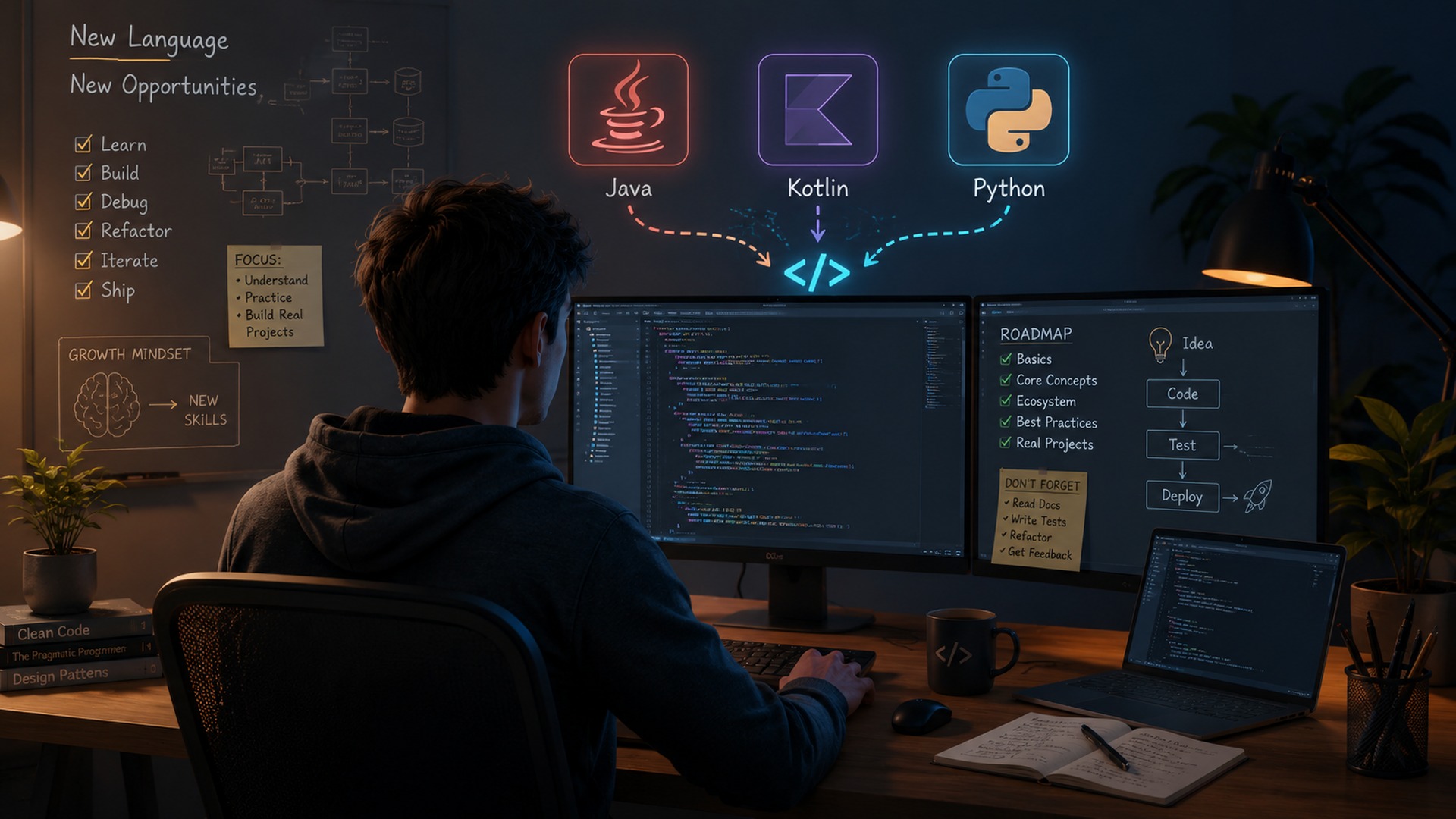
Adding a new programming language to your stack mid-career looks different from learning your first one. The fundamentals are already there — what's missing is the idiomatic fluency, ecosystem knowledge, and toolchain habits that make your code readable to practitioners of the new language, not just functional.
This guide covers the transitions working developers actually face: Java to Kotlin, Java to Python, Python to the JVM. What transfers immediately, what doesn't, realistic timelines, and the project-first approach that gets you to genuine productivity — not just familiarity.


like this
Create a free account to access the full topic


